
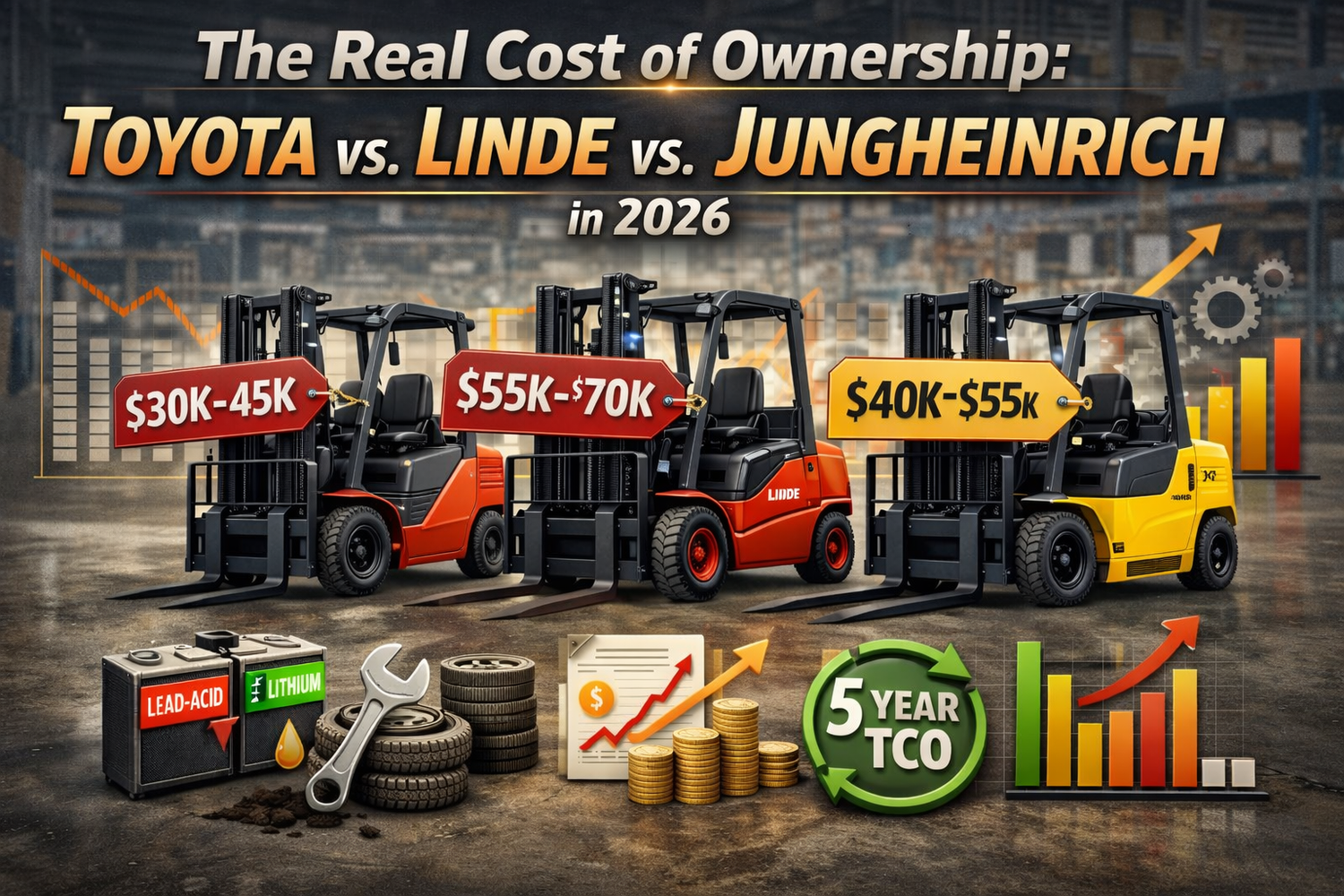
Purchase price is only the opening number. For a fleet manager, the real decision is five-year ownership cost: service cadence, battery strategy, tire wear, hydraulic maintenance, uptime risk, and what the truck is still worth when it leaves the fleet.
This comparison looks at Toyota, Linde, and Jungheinrich through that lens. It focuses on the 5,000-pound class because that is one of the most common sit-down counterbalance categories in mixed warehouse and yard fleets.
Pricing disclosure: exact OEM MSRP is often not posted publicly for these trucks. Where public dealer pricing is visible, this article uses those asking prices. Where public MSRP is not visible, it uses clearly labeled planning brackets anchored to current quote-only OEM availability and visible late-model market pricing. Final numbers vary with mast, battery, side-shift, charger, tires, warranty, and freight. [Source: Spokane Forklift] [Source: Logisnext Americas] [Source: G&W Equipment]
Public Price Anchors and 2026 Planning Brackets
| Brand | Truck Type | Current Public Price Anchor / Planning Bracket | How to Read It |
|---|---|---|---|
| Toyota | 5,000-lb IC / LPG | $43,950–$47,850 | Current public asking-price anchors for new 8FGU25 / 50-8FGU25 listings, not universal MSRP. [Source: LiftsToday] [Source: Eliftruck] |
| Toyota | 5,000-lb Electric | Planning bracket: about $35,000–$45,000 | Public new MSRP was not confirmed; bracket is inferred from current 5,000-lb-class 8FBCU25 market pricing reaching $32,000 for late-model trucks and the general premium normally attached to new-order electric configurations. [Source: MachineryTrader] [Source: LiftsToday] |
| Linde | 5,000-lb IC / LPG | $35,900 | Current public asking-price anchor for a new 2026 HT25T listing. [Source: Spokane Forklift] |
| Linde | 5,000-lb Electric | Planning bracket: about $50,000–$65,000 | Current public OEM-style product pages are quote-driven, not price-posted; this bracket reflects Linde’s premium electric positioning and service-centric value proposition rather than a published MSRP sheet. [Source: Linde Material Handling] |
| Jungheinrich | 5,000-lb IC / LPG | Planning bracket: about $38,000–$50,000 | Public current North American MSRP visibility is weak; this is a conservative planning range rather than a posted sticker price. |
| Jungheinrich | 5,000-lb Electric | Planning bracket: about $40,000–$55,000 | Current 5,000–6,500-lb-class electric models are presented as quote-only by current dealers and OEM distributors; late-model used 5,000-lb EFG425K listings provide the public market floor, not the new-order ceiling. [Source: Logisnext Americas] [Source: LiftsToday] |
The main takeaway is that Toyota’s IC pricing is easier to see in public, Linde’s IC side is competitive on visible asking prices, and both Linde electric and Jungheinrich electric require more quote-based budgeting discipline because public MSRP visibility is limited.
Where Five-Year TCO Actually Moves
Five-year forklift TCO usually changes in six places: purchase price, service frequency, battery strategy, hydraulic-service timing, tire consumption, and resale. On a 10,000-hour planning horizon, even small differences in service cadence can become a real line item in labor, downtime, and scheduling friction.
1. Maintenance Interval
Linde currently publishes one of the clearest electric-maintenance positions in this comparison. On its current Ei14–Ei20 line, Linde says overall inspection is due after 1,000 operating hours and hydraulic oil and filter change after 6,000 hours. [Source: Linde Material Handling]
Toyota’s published service materials show maintenance-plan visits at 250, 500, and 750 hours, while Toyota Materials Handling Solutions says IC forklifts generally need service every 250–300 hours. That does not automatically make Toyota expensive to own, but it does mean Toyota should be budgeted as the more frequent-touch brand in an apples-to-apples PM schedule. [Source: Toyota Forklifts Europe] [Source: Toyota Materials Handling Solutions]
Jungheinrich’s public English-language product pages emphasize electric efficiency and quote workflows more than a model-specific maintenance-hour table, so for budgeting I would treat Jungheinrich as roughly a 1,000-hour electric-planning brand only after dealer confirmation. The clean public support on Jungheinrich is stronger on energy recovery and lithium positioning than on a universal hour-based PM chart. [Source: Jungheinrich UK]
2. Battery Strategy
Battery strategy is where many fleets underbudget. RoyPow currently places a 48V lead-acid forklift battery at roughly $3,500 to $5,000 and a 48V lithium forklift battery at roughly $8,000 to $20,000+. Those are public benchmark ranges, not truck-specific installed quotes, but they are useful for budget framing. [Source: RoyPow]
Toyota’s own lithium program is more transparent on warranty than on sticker price. Toyota states its lithium-ion batteries are available with either a 5-year / 3,500-cycle warranty or an 8-year / 5,000-cycle warranty, depending on battery program and application. [Source: Toyota Material Handling]
Jungheinrich’s lithium story is similarly strong on lifespan. Jungheinrich currently promotes an Li-ion Guarantee Plus with up to 8 years of long-term performance promise, and its earlier corporate announcement described a 5-year performance warranty on lithium-ion batteries. That matters because the best electric TCO case is often not “cheapest battery,” but “no mid-cycle battery surprise.” [Source: Jungheinrich UK] [Source: Jungheinrich]
3. Efficiency and Energy Recovery
Jungheinrich states that its electric forklifts can feed back 30% of energy into the battery through regenerative braking. For a busy electric fleet, that is not a marketing footnote; it directly affects run time, charging frequency, and potentially the number of batteries or chargers the fleet needs to carry. [Source: Jungheinrich UK]
Toyota’s efficiency story in this comparison is more safety-driven than energy-driven. Toyota says SAS takes over 3,000 readings per second to detect unsafe operating conditions. That supports a better safety posture and can strengthen an insurance conversation, but I did not find a public insurer schedule showing a standard premium discount tied to SAS, so any insurance savings should be treated as possible but not guaranteed. [Source: Toyota Material Handling]
4. Hydraulic Service
Linde is the clearest brand here because it explicitly publishes the 6,000-hour hydraulic oil and filter interval on current electric models. [Source: Linde Material Handling]
Toyota and Jungheinrich absolutely require hydraulic maintenance, but I did not find a comparably clean, publicly posted, model-matched hydraulic-change interval for this exact 5,000-pound comparison set. For those brands, the right move is to get the hour table directly from the dealer before finalizing the TCO spreadsheet.
5. Tire Wear
Tire costs vary too much by environment to fake precision. A cushion-tire indoor truck and an outdoor pneumatic truck will not consume rubber the same way. The right budgeting approach is to reserve a higher tire line item for outdoor IC fleets and a lower one for indoor electric fleets, then adjust based on your actual floor condition, turning radius, and load profile.
6. Resale
Toyota usually has the strongest resale argument in North America because the public used-market depth is broader and easier to see. Current marketplace inventory for Toyota 8FGU25 and 8FBCU25 families is substantially deeper than what is visible for equivalent Linde or Jungheinrich comparison models, which generally supports faster remarketing and more predictable exit value. [Source: MachineryTrader] [Source: MachineryTrader] [Source: LiftsToday]
Bottom-Line Read for a Fleet Manager
Toyota is the easiest truck to justify when your priorities are resale, dealer coverage, and risk control. Its weakness is not reliability; it is that published service cadence is typically more frequent than Linde’s current electric interval structure. [Source: Toyota Forklifts Europe] [Source: Toyota Materials Handling Solutions]
Linde is the strongest pure maintenance-efficiency case in this comparison because it publicly supports long electric inspection and hydraulic intervals. If your fleet puts a hard dollar value on avoided service interruptions, Linde deserves a serious look even when buy-in is premium. [Source: Linde Material Handling]
Jungheinrich makes its best financial case in electric fleets. Regenerative braking, lithium positioning, and quote-driven electric configurations make it attractive when uptime per charge matters more than lowest entry price. [Source: Jungheinrich UK] [Source: Jungheinrich UK]
Need help comparing real forklift ownership cost, not just sticker price?
AAA Forklifts can help you compare purchase options, battery strategy, service implications, and long-term fit for your operation before you commit capital.
Compare Available Forklifts Explore Forklift ServiceFrequently Asked Questions
Which brand looks cheapest up front?
On publicly visible new IC asking prices in this comparison, Linde’s HT25T currently shows the lowest clear public anchor at $35,900, while Toyota’s visible 8FGU25 anchors are higher. Public MSRP visibility for new electric trucks is weaker and more quote-driven. [Source: Spokane Forklift] [Source: LiftsToday]
Which brand has the clearest maintenance advantage on public documentation?
Linde does, because it explicitly publishes a 1,000-hour overall inspection interval and a 6,000-hour hydraulic oil and filter interval on current electric models. [Source: Linde Material Handling]
Does Toyota SAS guarantee lower insurance premiums?
No public insurer schedule was found that guarantees a standard premium discount for SAS. It supports a stronger safety case, but fleets should verify any insurance impact with their own carrier. [Source: Toyota Material Handling]
Why is Jungheinrich strong on electric ROI?
Because Jungheinrich publicly emphasizes regenerative braking with 30% energy fed back into the battery and also backs lithium with long-duration guarantee messaging. That combination matters in high-utilization electric fleets. [Source: Jungheinrich UK] [Source: Jungheinrich UK]

Leave a comment
This site is protected by hCaptcha and the hCaptcha Privacy Policy and Terms of Service apply.