
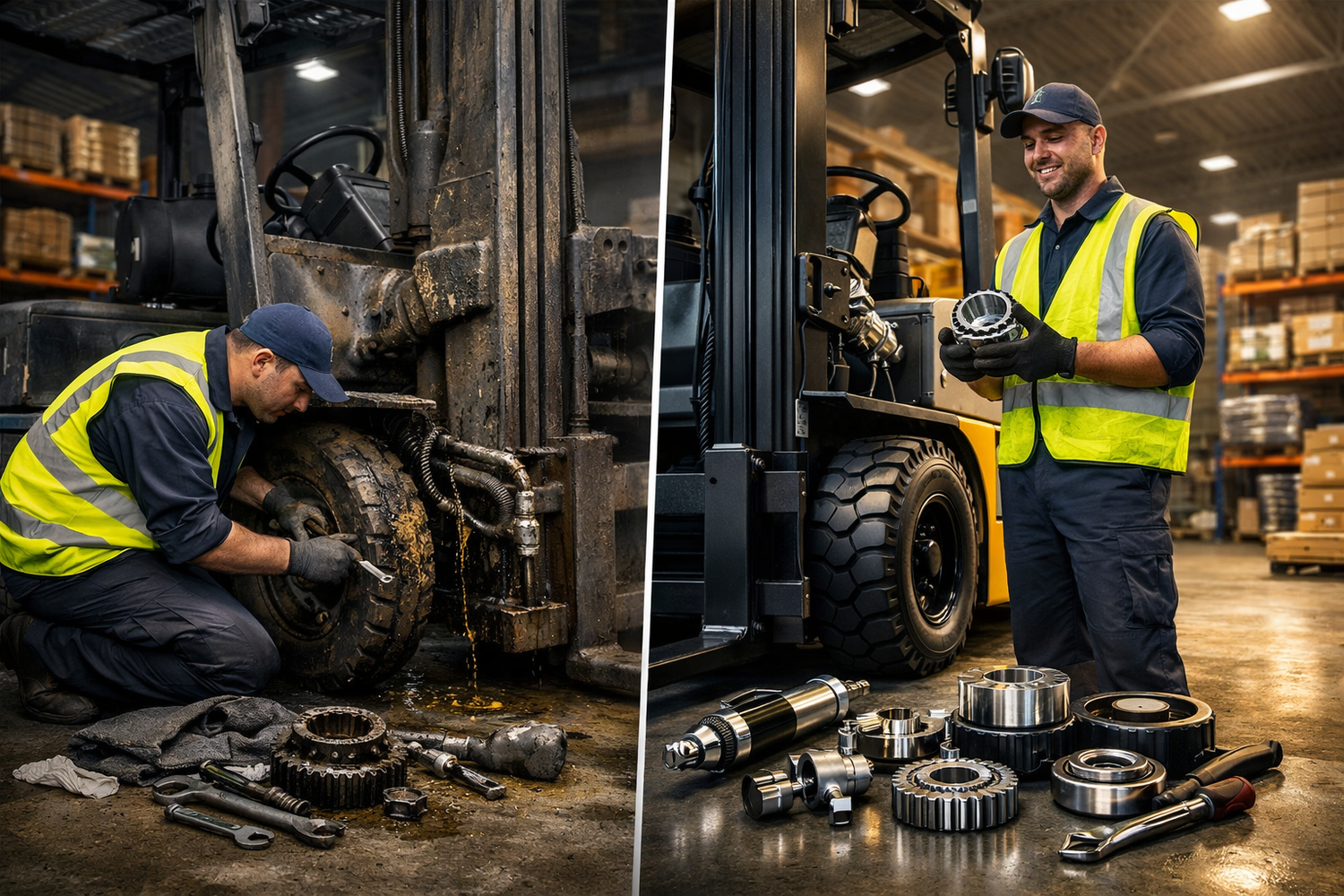
Stop Wasting Money on Forklift Repairs — Know Exactly When to Repair or Replace Parts
Most forklift owners don’t lose money on equipment—they lose money on bad repair decisions. Fixing the wrong part at the wrong time leads to repeat failures, unexpected downtime, and thousands in avoidable costs.
Quick Answer: Replace forklift parts when repair costs exceed 60%, safety is compromised, or failure risk is high. Repair only when the issue is isolated, low-cost, and won’t trigger further damage.
The Real Cost of “Just Repair It”
Here’s where most businesses get it wrong: they treat repairs like savings. In reality, the wrong repair often delays failure instead of preventing it. That delay turns into more downtime, more labor, and more damage to surrounding components.
A leaking hydraulic hose doesn’t stay a hose problem—it becomes a pump issue. A worn tire doesn’t stay a tire issue—it affects stability and load handling. Every worn component you ignore increases the load on something else.
When You Should Repair Forklift Parts
Repairing forklift parts makes sense—but only under the right conditions. You’re looking for controlled, predictable fixes—not temporary band-aids.
- Minor hydraulic leaks (seals, fittings)
- Single electrical component failures
- Routine wear items (filters, spark plugs, belts)
- Tires with safe remaining tread
- Surface wear without structural damage
If the issue is isolated, inexpensive, and doesn’t impact surrounding systems, repair is the right move. These are predictable fixes with low risk and fast ROI.
When You Should Replace Forklift Parts
Replacement isn’t a cost—it’s a reset. It restores reliability, eliminates recurring issues, and protects the rest of your machine.
- Repair cost exceeds 60–70% of replacement
- Recurring failures on the same component
- Safety-critical parts (brakes, mast, chains)
- Hydraulic cylinders with internal damage
- Electrical system failures affecting multiple components
If the part has already failed once and shows signs of failing again, you’re not fixing it—you’re managing failure. That’s when replacement wins every time.
Repair vs Replace Decision Rule
If the repair is cheap and isolated → Repair.
If the failure spreads risk or repeats → Replace.
If safety is involved → Replace immediately.
High-Risk Components You Should Never Gamble On
Some forklift parts are not worth the risk. When these fail, the consequences go beyond repair costs—they affect safety, liability, and operations.
Hydraulic Systems
Leaks, pressure loss, or erratic movement are early warning signs. Ignoring them leads to full system failure and expensive rebuilds.
Mast & Chains
These components carry the load—literally. Wear, stretch, or damage here creates serious safety risks and should never be ignored.
Brakes & Tires
Stopping power and stability are non-negotiable. If performance drops, replacement is the only safe option.
How Smart Operators Reduce Costs Long-Term
The lowest-cost strategy isn’t repair or replace—it’s knowing when to do each. That’s where preventive maintenance comes in.
Routine inspections catch wear before failure. Scheduled maintenance reduces emergency repairs. And planned replacements eliminate downtime surprises.
Frequently Asked Questions
How often should forklift parts be inspected?
Daily checks with monthly or 200-hour professional inspections are recommended.
Is it cheaper to repair or replace forklift parts?
Repairs are cheaper short-term, but replacement is more cost-effective when failures repeat.
What part fails most often?
Hydraulic hoses, tires, and electrical components are the most common wear items.
When should I replace hydraulic components?
When leaks persist, pressure drops, or movement becomes inconsistent.
Avoid Costly Forklift Breakdowns
Whether you need parts, repairs, or a full evaluation, AAA Forklifts helps you make the right decision the first time.
Request ServiceCall Orlando (407) 695-4387 or Raleigh (919) 925-2217


Leave a comment
This site is protected by hCaptcha and the hCaptcha Privacy Policy and Terms of Service apply.