
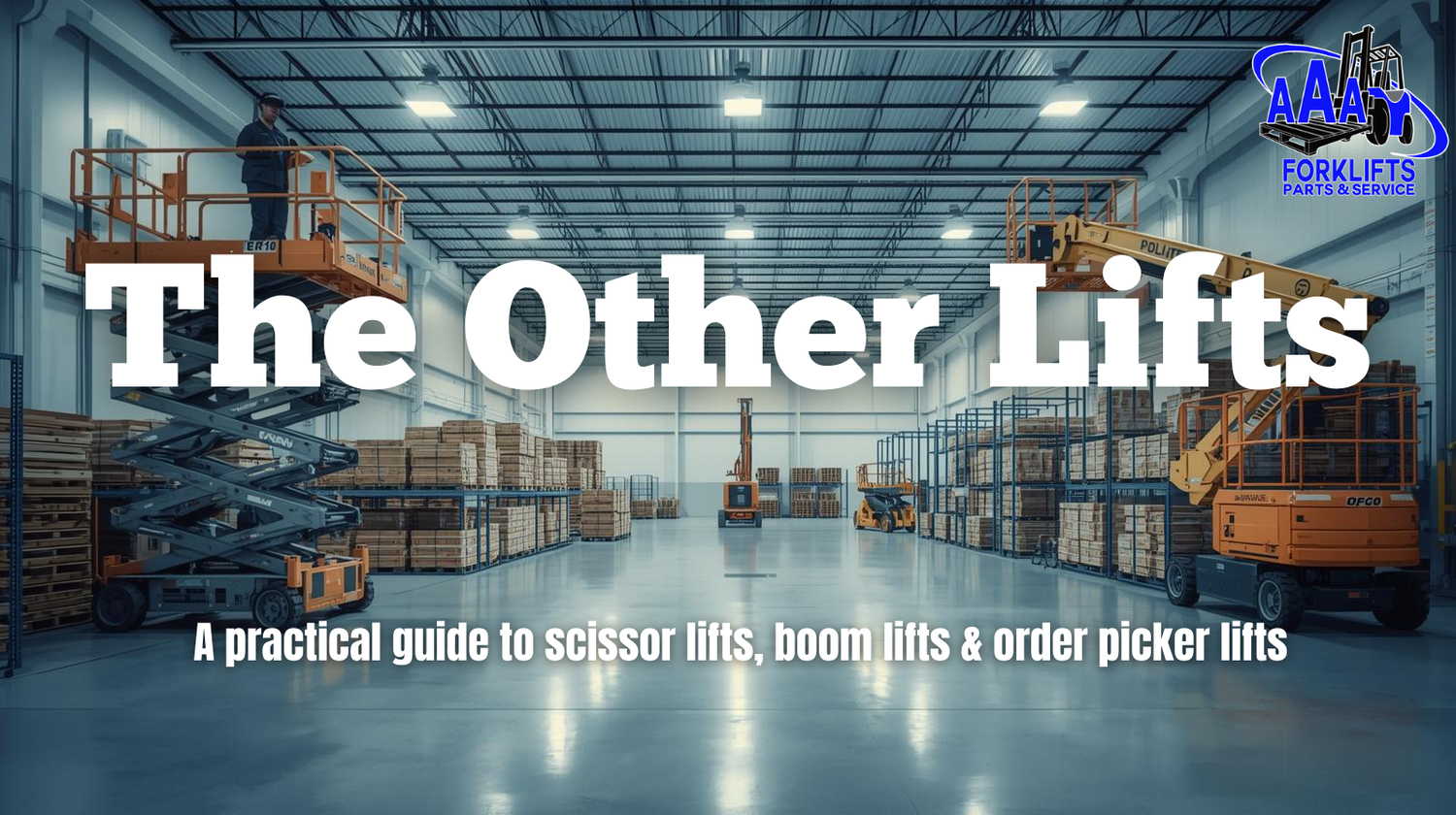
Not every job that "goes up" needs a traditional forklift. In a lot of cases, using a forklift for elevated work is slower, harder on your equipment, and less safe than using the right type of lift that was designed for the job.
This guide breaks down the other lifts you see in warehouses, plants, and construction sites — scissor lifts, boom lifts, order pickers, vertical mast lifts, personnel lifts, and more. You will learn what each one does, when it makes sense to use it, and how choosing the right lift can protect your people, inventory, and equipment budget.
Think of it as a quick roadmap: when a scissor lift is the smartest choice, when a boom lift is worth the reach, and when an order picker lift will quietly save you hundreds of steps and dozens of ladder trips every shift.
Quick takeaway: Forklifts are built to move loads. Aerial work platforms are built to lift people and tools safely. When you match the right lift to the right task, jobs move faster and your risk goes down.
Not Everything That Goes Up Is a Forklift
Forklifts are incredibly versatile, which is why they get used for all kinds of jobs they were never really designed to do. A common example: lifting a work platform or pallet with a person on it to "just quickly" change a light, run wiring, or do building maintenance.
The problem is that a forklift's stability, controls, and safety features are built around handling palletized loads, not people. That is why you now see so many other types of lifting equipment in warehouses and facilities — each one solves a specific vertical-access problem more safely and efficiently than simply improvising with a forklift.
Before we look at scissor lift options, different types of boom lift, and how an order picker lift actually works, it helps to understand the broader category they fall into: aerial work platforms.
What Is an "Aerial Work Platform"?
An aerial work platform (AWP) is any piece of equipment that is designed to lift people, tools, and materials to a working height above the ground. Unlike forklifts, AWPs usually have guardrails, entry gates, emergency controls, and platform controls that allow the operator to position themselves safely while working.
Common types of aerial work platforms include:
Scissor lifts – go straight up and down for stable, vertical access.
Boom lifts – provide both height and horizontal reach to work over obstacles.
Order pickers – lift the operator with the load for case picking in racking.
Vertical mast / personnel lifts – compact platforms for tight indoor spaces.
All of these are designed from the ground up to put people in the air as safely and efficiently as possible — which is something a traditional forklift is only meant to do in very specific, approved configurations.
Scissor Lifts — Vertical Access Done Right
A scissor lift is one of the most common "other lifts" you will see in a warehouse or plant. It uses a crisscrossing (scissor-like) structure to raise a work platform straight up and down.
When someone calls in asking about a manlift or "small lift that just goes up and down," they are usually describing some kind of scissor lift — and choosing the right configuration upfront has a big impact on safety and productivity.
When a Scissor Lift Is the Best Choice
Scissor lifts excel when you need a stable work platform directly above the base of the machine. Typical jobs include:
Indoor maintenance: light fixtures, HVAC work, running conduit, installing sprinklers.
Warehouse work: signage, racking repairs, dock door adjustments, wall inspections.
Flat-surface projects: anything where the floor is smooth, firm, and level.
Because a scissor lift focuses on vertical motion, it is usually the simplest and most stable option for repetitive overhead tasks — especially compared to ladders, rolling stairs, or improvised platforms on a forklift.
Why Scissor Lifts Are Safer Than Forklifts for Overhead Work
Compared to a makeshift forklift platform or a ladder, a properly selected scissor lift offers:
Guarded workspace: guardrails and entry gates help keep workers on the platform.
Stable base: the lift is designed for vertical loads, not cantilevered pallets.
Built-in controls: platform controls let the operator position the lift precisely without relying on a second person.
All of this reduces the risk of falls and tip-overs compared to improvising with a forklift or using a ladder for jobs that really need a platform. When you add in training and a preventive maintenance plan, a scissor lift becomes one of the safest tools in the building for overhead work.
Electric vs. Rough-Terrain Scissor Lifts
Not all scissor lifts are the same. Two common categories are:
Electric scissor lifts: usually used indoors. They have non-marking tires, quieter operation, and zero on-site emissions — ideal for warehouses, retail backrooms, and manufacturing facilities.
Rough-terrain scissor lifts: designed for construction sites and outdoor work. They often have larger, more aggressive tires, higher ground clearance, and may be diesel or dual-fuel powered.
Choosing the right scissor lift depends on where it will be used, what surface it will drive on, and how high you need to go. AAA Forklifts can help you compare models and decide whether it makes more sense to own a scissor lift or rely on rentals during busy seasons.
Boom Lifts — When You Need Height and Reach
While scissor lifts go straight up and down, a boom lift can reach out over obstacles, making it ideal for jobs that are not directly above the machine's base. If you need to work over machinery, dock canopies, landscaping, or structures, a boom is often the only safe option.
A boom lift also gives you more flexibility in how you position the base of the machine. Instead of blocking an aisle or parking right under the work area, you can set the boom back in a safer spot and "reach in" to where the work needs to be done.
Articulating vs. Telescopic Boom Lifts
Jobs a Forklift Should Not Be Used For
Choosing the Right Boom Lift for Your Site
When you are comparing boom lifts, it is tempting to look only at maximum platform height. In reality, you want to think about how the boom lift will be used day-to-day:
Work envelope: Do you need to reach straight up, up-and-over, or far across roofs, docks, or landscaping?
Ground conditions: Is the boom lift going to live on smooth concrete, or will it need rough-terrain capability?
Transport and storage: Do you have space to stage a larger boom lift, or is a more compact model easier to manage?
Matching the boom to the real job helps you avoid overspending on equipment that is bigger than you need — or worse, under-sizing a boom lift that cannot safely reach the work area.
Safety and Training Considerations
Boom lifts require proper operator training. The higher you go and the further you reach, the more important it becomes to understand:
Partnering with an experienced equipment provider helps you match the right boom lift to the job and the site conditions — instead of just choosing based on height alone.
Order Pickers — Built for Modern Warehouses
An order picker forklift is one of the most important "other lifts" in high-volume distribution centers. Instead of lifting only a pallet, order pickers are designed to lift the operator along with the load so they can pick individual cases or items directly from racking.
Many teams casually refer to this equipment as an order picker lift — a powered lift truck where the platform and forks go up together. Getting the right order picker lift setup has a direct impact on pick rates, accuracy, and operator fatigue.
How Order Pickers Work
On an order picker, the operator stands on a small platform that rises and lowers with the forks. This lets them pick cases or pieces directly into a pallet, cage, or cart at height. Controls are mounted at the operator's position, so they can drive, lift, and position themselves without leaving the platform.
A well-matched order picker lift will have the right combination of lift height, travel speed, and platform size to fit your aisles and your product mix — whether you are picking small cartons, bulky items, or mixed-case pallets.
Why Order Pickers Beat Ladders and Pallet Jacks
In a modern warehouse, ladders and pallet jacks can only take you so far. Order pickers offer:
Higher productivity: operators stay at height and can move quickly from pick to pick.
Better ergonomics: less climbing, twisting, and carrying heavy cases down ladders.
Improved accuracy: operators can see labels and SKUs clearly while building orders.
For e-commerce, 3PL, and high SKU-count operations, an order picker lift is often the backbone of the picking process, especially in medium and high-bay racking where ground-level picking is simply not fast enough.
Battery and Duty-Cycle Planning
Because order pickers are used heavily in many facilities, they place real demands on the power system that supports them. High lift heights, frequent travel, and long shifts all add up. If power and uptime are undersized, trucks can slow down or be sidelined in the middle of a shift.
Planning for the right duty cycle means thinking through:
Hours of operation: how many hours per day and per week the truck will actually run.
Lift frequency: how often the truck will be lifting to medium and high heights.
Charging windows: when and where operators can safely plug in equipment without disrupting the workflow.
Matching the order picker lift specification to the real workload up front helps reduce downtime and protect your investment in both the trucks and the systems that keep them moving.
Vertical Mast and Personnel Lifts — Small but Essential
Vertical mast lifts and personnel lifts are compact elevated work platforms designed for tight spaces and lighter loads. You will often see them in retail stores, smaller warehouses, and facilities where a full-size scissor lift is too large.
Where Compact Lifts Make Sense
Tight aisles and backrooms: small footprints and narrow widths let these lifts maneuver where larger equipment cannot.
Light maintenance tasks: changing signs, working on light fixtures, or doing small repairs in confined spaces.
Public-facing environments: compact lifts can be easier to use safely in retail or commercial spaces outside peak hours.
Common Misuse to Watch For
Even in facilities that own vertical mast or personnel lifts, it is common to see ladders or improvised forklift platforms pulled out for "quick" jobs. Over time, these shortcuts can lead to near-miss incidents and recordable injuries that would have been avoided by using the right lift every time.
Choosing the Right Lift: Five Questions That Prevent Costly Mistakes
When you are deciding between a forklift, scissor lift, boom lift, order picker lift, or personnel lift, start by answering a few simple questions:
1. Do You Need Height, Reach, or Both?
If the work is directly overhead, a scissor lift or vertical mast lift may be enough. If you need to reach over equipment, landscaping, or structures, a boom lift is usually safer and more efficient.
2. Will the Lift Work Indoors, Outdoors, or Both?
Indoor work often calls for electric scissor lifts, order pickers, or personnel lifts with non-marking tires. Outdoor construction or site work may require rough-terrain scissor lifts or booms with higher ground clearance and different power sources.
3. How Often Will the Equipment Be Used?
For occasional maintenance, owning a large fleet of lifts may not be necessary — rentals or a single versatile unit could be enough. For daily use in order picking or facility maintenance, it is worth investing in the right equipment and a solid preventive maintenance program.
4. What Does the Floor or Ground Look Like?
Smooth warehouse floors, outdoor gravel, and sloped concrete all call for different types of lifts. Selecting equipment without considering floor conditions can limit where you can safely operate and may increase the risk of damage or accidents.
5. Who Will Operate the Lift?
Operator training is not optional. The more complex the lift, the more important it is to have trained, authorized operators. That includes understanding load limits, platform controls, emergency procedures, and how to recognize unsafe conditions before leaving the ground.
Need help matching equipment to your operation?
AAA Forklifts can walk your facility and help you decide when a forklift makes sense — and when another type of lift is the safer, more cost-effective choice.
The Hidden Cost of Using the Wrong Lift
Using a forklift for jobs that really call for an aerial work platform can feel convenient in the moment — but the hidden costs add up over time.
Downtime: improvised work methods are usually slower, tying up both equipment and people longer than necessary.
Equipment damage: pushing forklifts beyond their intended use can shorten component life and increase repair bills.
Battery and engine wear: lifts that are undersized or misused often work harder than they should, which can drive up fuel and energy costs.
Safety and compliance risk: falls from height, tip-overs, and unplanned contact with structures or product can lead to injuries, claims, and regulatory issues.
When you compare those risks to the cost of choosing the right lift — whether that is a compact scissor lift for maintenance, a boom lift for dock canopies, or an order picker lift for high-bay picking — it is easy to see why more facilities are investing in a combination of forklifts and dedicated aerial work platforms instead of forcing one type of equipment to do everything.
Real-World Examples of Choosing the Right Lift
It can be helpful to see how these decisions play out in real operations. Here are a few common scenarios where selecting the right "other" lift makes a noticeable difference in cost, safety, and productivity.
From Ladders to Order Pickers in a Busy Warehouse
A distribution center that relied on ladders and pallet jacks for case picking started to see more near-misses and slower order turnaround times as volume increased. Operators were carrying heavy cases down ladders, and it was difficult to maintain both speed and accuracy.
After switching key pick zones to order picker forklifts and standardizing on a well-specified order picker lift fleet, the operation saw:
Fewer interruptions: operators stayed at height and moved directly from pick face to pick face.
Better inventory control: it was easier to see and scan SKUs while building pallets at the correct levels.
Improved ergonomics: less climbing and twisting reduced strain on operators over long shifts.
Replacing Improvised Platforms with Scissor Lifts
A facility that used a combination of forklifts and makeshift platforms for maintenance eventually recognized that "quick" jobs at height were becoming a regular part of the workweek. Instead of treating every task as a one-off, they invested in an electric scissor lift matched to their typical ceiling heights and floor conditions.
The change allowed maintenance teams to:
Standardize procedures: everyone used the same lift and the same fall-protection practices.
Reduce setup time: jobs that once required finding a compatible forklift and platform turned into a simple, repeatable process.
Protect forklifts: trucks could get back to what they were designed to do — moving product — instead of being tied up for overhead work.
Using Boom Lifts to Reach Over Obstacles
In another operation, building maintenance crews needed to access lights and roof features above canopies, landscaping, and parked equipment around a loading dock. Forklifts and straight vertical lifts could not safely reach over these obstacles without complicated setups.
Moving to articulating boom lifts gave crews:
Cleaner access to the work area: they could position the base out of the way and "reach over" obstructions.
Less disruption to dock activity: loading and unloading could continue while maintenance work happened overhead in a controlled manner.
Better risk management: the right boom lift meant fewer compromises in positioning and a more predictable way to plan repeat maintenance tasks.
In each of these examples, the key wasn't buying the biggest or most complex lift — it was choosing the equipment that matched the work, the facility, and the people doing the job.
Where AAA Forklifts Fits In
Whether you're running a small warehouse or a multi-site operation, you don't have to figure out your lift strategy alone. AAA Forklifts works with businesses throughout Orlando, Tampa, and Central Florida, as well as Raleigh and the surrounding North Carolina markets, to keep the right equipment under the right operators.
Our team can help you:
Review your current fleet: forklifts, aerial lifts, and support equipment.
Identify gaps and risks: where you may be relying on ladders or forklifts for work that should be done from a platform.
Plan maintenance: preventive maintenance for both forklifts and lift equipment so you stay ahead of problems instead of reacting to breakdowns.
If you're ready to take a fresh look at the lifts in your operation — and how safely and efficiently your people work at height — AAA Forklifts is here to help.
Have questions about forklifts, scissor lifts, boom lifts, order picker lifts, or other equipment in your fleet? Reach out and our team will help you sort through options based on your facility, budget, and safety goals.
Orlando & Central Florida
AAA Forklifts – Orlando, FL
Phone: (407) 695-4387
Address: 2699 N Forsyth Rd, Orlando, FL 32807
Raleigh, NC & Surrounding Areas
AAA Forklifts – Raleigh, NC
Phone: (919) 925-2217
Address: 2700 Gresham Lake Rd. Unit #0440, Raleigh, NC 27615
General email: info@aaaforklifts.com
Frequently Asked Questions About Lift Equipment
Can a forklift safely lift people for overhead work?
In very specific situations, a forklift can be used with an approved work platform and trained operators — but it is not the best or safest tool for most overhead work. Aerial work platforms such as scissor lifts, boom lifts, order picker lifts, and personnel lifts are designed from the ground up to lift people and tools, with guardrails, entry gates, and platform controls to reduce risk.
What is the safest type of lift for indoor maintenance in a warehouse?
For most indoor maintenance tasks on smooth, level floors, an electric scissor lift or a compact vertical mast lift is the safest option. These machines provide a stable platform, non-marking tires, and precise positioning so maintenance teams can work at height without relying on ladders or improvised forklift platforms.
Do I need special training to operate a scissor lift or boom lift?
Yes. Just like forklifts, aerial work platforms require proper operator training. Operators need to understand how to read the capacity chart, recognize unsafe conditions, use platform controls correctly, and follow site-specific procedures. Investing in training is one of the most effective ways to reduce incidents when working at height.
Which type of lift is best for order picking in racking?
For case or piece picking in racking, a dedicated order picker forklift is usually the best choice. It lifts the operator with the load, allowing them to pick items directly into pallets or containers at height. This approach improves productivity, accuracy, and ergonomics compared to using ladders and pallet jacks for the same work — especially when you standardize on the right order picker lift for your aisles and SKU mix.

Deja un comentario
Este sitio está protegido por hCaptcha y se aplican la Política de privacidad de hCaptcha y los Términos del servicio.