
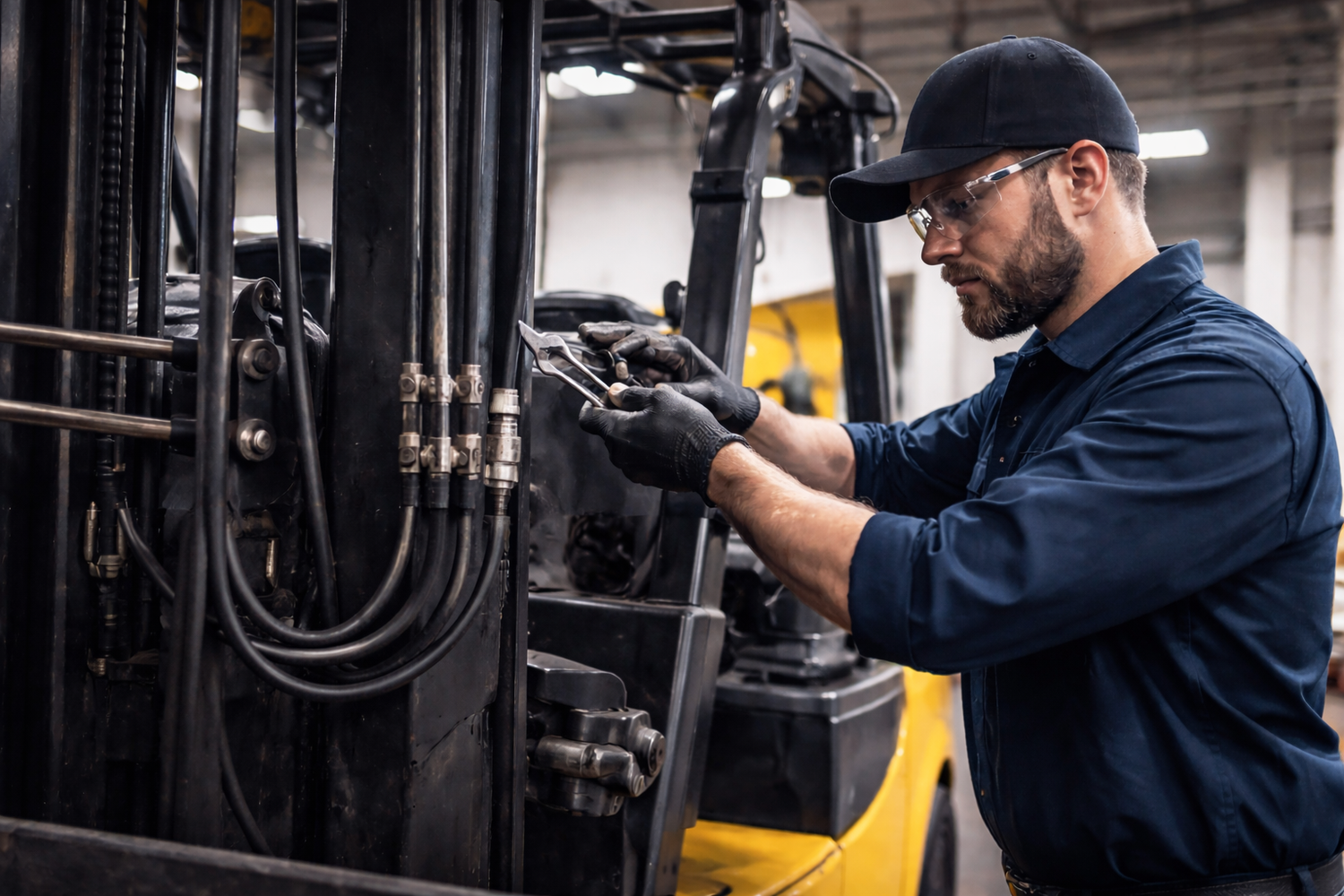
Hydraulic hose failures do not happen gradually. One moment equipment is operating normally — the next, pressure drops, fluid sprays, and operations stop immediately.
For forklifts, lift equipment, and industrial machinery used across Orlando, Central Florida, and Raleigh, hydraulic hose failure creates instant downtime, safety exposure, and unplanned cost. Professional hydraulic hose repair is not just about replacing a damaged line — it is about restoring system integrity and preventing the next failure before it occurs.
On-site and in-shop support • Orlando & Raleigh
Since 2013, AAA Forklifts and AAA Hydraulic Services have supported material handling, construction, and industrial businesses with on-site and in-shop hydraulic hose repair, custom hose fabrication, and full hydraulic system service. Our focus is accuracy, safety, and long-term reliability — not temporary fixes that lead to repeat failures.
Why Hydraulic Hoses Fail
Hydraulic hoses operate under extreme conditions. High pressure, constant vibration, temperature fluctuation, and repeated movement all place stress on hose assemblies. Over time, even properly installed hoses degrade. Failures are rarely random and almost always follow predictable patterns.
Common causes of hydraulic hose failure include abrasion from contact with forklift masts or frames, improper routing that creates tight bend radii, heat damage from engines or exhaust components, chemical exposure, incorrect hose ratings, and crimp fatigue at fittings.
Forklifts are especially demanding on hoses because mast movement constantly flexes lift and tilt circuits during normal operation. When a hose fails, hydraulic fluid loss does more than stop motion. It can contaminate the system, damage seals, introduce air into the circuit, and create slipping hazards. That is why professional diagnosis and correct hose replacement matter far more than a quick temporary fix.
What To Do Immediately After a Hose Failure
Quick-response checklist:
Shut down the unit • Lower the load safely if possible • Isolate and mark the spill area • Do not "limp" the machine to finish the task • Arrange correct hose replacement and inspect routing before returning to service.
The goal is to prevent secondary damage. Running with low fluid or aerated fluid can accelerate pump wear and damage seals. If a hose failed near a mast, steering, or braking circuit, treat the situation as a safety event — not just maintenance.
Hydraulic Hose Repair vs Replacement
A frequent question is whether a hydraulic hose can be repaired or if it should be replaced entirely. In practice, replacement is usually the safest and most reliable option. Hydraulic hoses are engineered assemblies — and damage to the inner tube or reinforcement layers cannot be safely reversed.
⚠️ Critical consideration: A properly fabricated hose assembly ensures correct pressure rating, correct fittings, accurate length, and correct routing. Reusing a compromised hose may reduce short-term cost but dramatically increases the risk of sudden failure, downtime, and liability.
If the problem looks like a hose but the leak source is unclear, the right move is diagnosis before replacement. That reduces repeat service calls and prevents "fixing the symptom" instead of the root cause.
The True Cost of Hydraulic Downtime
Downtime costs extend far beyond the price of a replacement hose. Idle forklifts disrupt material flow, slow production lines, and create bottlenecks throughout an operation. Labor stands idle while delivery schedules slip.
⏱️ Operational impact
Disrupted material flow, production delays, and missed deadlines.
⚠️ Safety risks
Fluid spills, uncontrolled loads, and possible loss of steering/braking response.
Hydraulic failures also introduce safety exposure. Fluid spills create slipping hazards. Loss of hydraulic pressure can result in uncontrolled load movement or reduced control response. Proper hydraulic hose service reduces both operational disruption and safety risk.
Diagnosing Hydraulic Leaks Correctly
Not every hydraulic leak originates from a failed hose. Fittings, O-rings, cylinder seals, pump housings, and cracked ports can all mimic hose failure. Misdiagnosis leads to unnecessary replacements and repeat service calls.
🔍 Proper diagnosis means inspecting crimp connections, fitting faces, hose routing, and nearby components before deciding what to replace. Fixing the real leak source the first time prevents repeat downtime.
If your leak is recurring, it may indicate a deeper system issue — for example, pressure spikes, heat stress, or movement that is cutting into the hose. In those cases, the correct repair includes addressing routing and protection, not just swapping parts.
Forklift Hydraulic Hose Systems Explained
Forklifts rely on multiple hydraulic circuits including lift, tilt, steering, braking, and auxiliary attachments. Each circuit experiences different pressures, movement patterns, and wear characteristics.
Critical forklift hose circuits:
• Mast lift hoses
Constant flexing as the carriage raises and lowers.
• Tilt hoses
Absorb shock loads and motion during load handling.
• Steering / brake hoses
Require consistent pressure for safe control response.
• Side-shift / attachment hoses
Higher abrasion risk due to lateral movement and routing.
Because forklifts operate in confined spaces, hose routing precision is critical. Incorrect hose length or routing can cause premature wear even on new hoses. Forklift-specific experience matters when fabricating and installing hydraulic hoses.
Preventive Maintenance and Inspection
Preventive inspection significantly reduces unexpected hose failures. Visual inspections should check for abrasion, cracking, swelling, leaks at fittings, and improper routing. External damage often indicates internal deterioration.
⏰ Early detection allows hoses to be replaced during scheduled downtime rather than during emergency shutdowns. Include hydraulic hose inspection in your regular forklift preventive maintenance program.
If your team already runs a planned maintenance schedule, this is the easiest win: add hose routing and abrasion checks to each interval so you replace assemblies before they fail in the middle of a shift. Learn more about our maintenance approach here: Planned Maintenance Service.
Hose Ratings, Pressure, and Compatibility
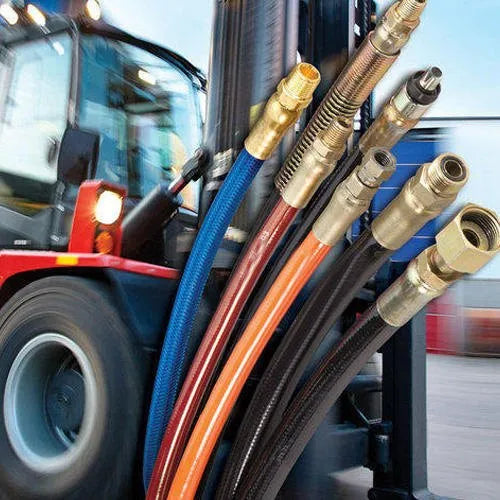
Hydraulic hoses are selected based on pressure rating, impulse life, temperature range, fluid compatibility, and minimum bend radius. Using the wrong hose type increases failure risk even if the hose "fits" physically. Correct selection also depends on how the hose moves during operation — especially on forklift masts and attachments where flexing is constant.
External reference (SAE):
SAE provides recommended practices for hydraulic hose assemblies — including selection, routing, installation, replacement, and maintenance: SAE J1273 Recommended Practices for Hydraulic Hose Assemblies.
Environmental Factors That Accelerate Hose Failure
Heat, chemicals, debris, and moisture all affect hose lifespan. Florida heat and humidity can accelerate rubber degradation, while temperature swings and seasonal changes in North Carolina stress materials differently. Add in abrasive dust, tight routing, and vibration — and you get failure conditions that repeat unless the root cause is corrected.
When the leak isn't just a hose
If inspection points to cylinders or pumps (not the hose itself), these services may be the right next step: Hydraulic Cylinder Rebuilds and Hydraulic Pump Rebuilds.
Hydraulic Hose Repair You Can Rely On
From emergency on-site hose replacement to precision in-shop fabrication, AAA Forklifts supports businesses across Orlando and Raleigh with professional hydraulic service focused on reliability — not repeat failures.
Request Hydraulic ServiceOrlando • Central Florida • Raleigh • Same-Day Service Available
Prefer a form? Use our contact page: Contact Us
Hydraulic Hose Repair FAQs
Can hydraulic hoses be custom-built?
Can hydraulic hoses be custom-built?
Yes. Custom hydraulic hoses are fabricated to match pressure requirements, fittings, length, and application.
How often should hoses be inspected?
How often should hoses be inspected?
At every preventive maintenance interval or whenever leaks or abnormal behavior appear.
Can fittings be reused?
Can fittings be reused?
Reusing fittings depends on condition and compatibility and is not always recommended.
Do you offer on-site hydraulic hose repair?
Do you offer on-site hydraulic hose repair?
Yes. Mobile service is available when equipment cannot be transported.
Do you service Raleigh, North Carolina?
Do you service Raleigh, North Carolina?
Yes. AAA Forklifts provides hydraulic hose repair and system service in both Orlando and Raleigh, with same-day emergency service available for critical repairs.
Want a simple way to catch problems before they become downtime?
Download our free inspection report and use it as a quick reference for what your team should check: Free Inspection Report (PDF).

Deja un comentario
Este sitio está protegido por hCaptcha y se aplican la Política de privacidad de hCaptcha y los Términos del servicio.