
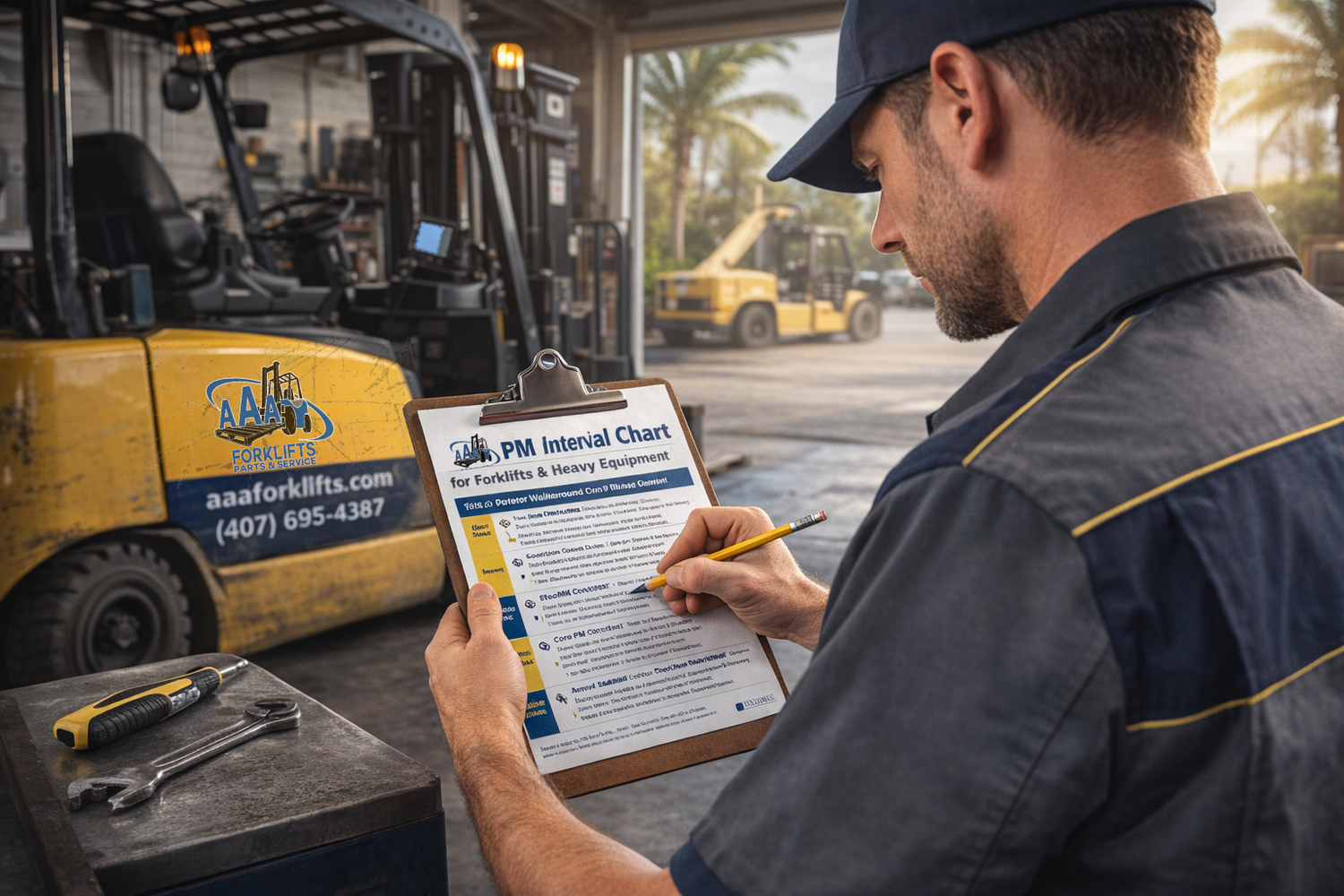
Preventive Maintenance That Actually Prevents Breakdowns
If your maintenance plan only activates when a machine is already down, you’re paying the most expensive rate: emergency labor, rushed parts, and lost production. Preventive Maintenance (PM) flips the script. Instead of reacting, you control uptime with scheduled inspections, lubrication, adjustments, and planned replacement of wear items.
This guide is written from an experienced mechanic’s point of view and meant for a mixed audience: operators, supervisors, safety teams, maintenance managers, and owners. Whether you run forklifts indoors all day, heavy equipment outdoors, or a blended fleet across both, PM is the most reliable way to reduce downtime without guessing.
Start with a baseline inspection, then build a PM interval that matches your hours, environment, and workload. We support blended fleets across Orlando/Central Florida and Raleigh/Eastern North Carolina.
- Preventive maintenance prevents breakdowns — not paperwork.
- Hours, calendar, and condition should all trigger service.
- Skipping PM increases downtime, safety risk, and total cost.
- Blended PM programs outperform calendar-only schedules.
Why Preventive Maintenance Works (The Shop-Floor Truth)
Most downtime doesn’t come from “random failure.” It comes from repeatable patterns: hoses rubbing on brackets, coolers packing with debris, chains stretching, brakes wearing past safe limits, tires losing stability, and electrical connections loosening from vibration. When PM is skipped, small issues keep running until they become a breakdown — usually at the worst possible time.
A blended fleet makes this obvious. Forklifts are hard on lift systems, hydraulics, steer axles, brakes, and electrical connections. Heavy equipment adds dirt, heat, outdoor exposure, pivot wear, and attachment stress. The machines are different, but the physics is the same: friction, heat, contamination, vibration, and deferred repairs.
Planned work beats surprise work. PM turns “emergency calls” into scheduled service windows. That protects shipping schedules, jobsite timelines, and operator productivity — and it makes parts planning possible.
If you’re constantly “one breakdown away” from falling behind, PM is how you buy back control.
Brakes, steering, forks/attachments, lift chains, tires, and safety devices don’t fail politely. A consistent inspection habit reduces risk and supports a culture where unsafe equipment is identified and corrected.
In simple terms: PM helps keep your people safe and your equipment fit for service.
The invoice is only part of breakdown cost. Downtime includes idle labor, missed deadlines, rental replacements, overtime, and disruption that never shows up on a parts list. PM keeps repairs smaller and predictable.
Good PM doesn’t eliminate repairs — it prevents the expensive ones.
In Orlando/Central Florida and Raleigh/Eastern North Carolina, heat, humidity, and mixed indoor/outdoor use can accelerate corrosion, cooler blockage, seal wear, and electrical connection issues. That’s why “generic PM intervals” often fail — a practical program matches your workload and environment.
PM Interval Chart for Forklifts & Heavy Equipment (A Practical Starting Point)
PM intervals can be built three ways: hours-based, calendar-based, and condition-based. The best fleets use all three. Hours-based intervals keep high-use machines from outrunning their service schedule. Calendar-based intervals catch aging issues on standby equipment. Condition-based intervals shorten service windows when heat, dust, corrosive environments, or severe duty accelerate wear.
- Check for leaks under the machine (hydraulic, coolant, fuel)
- Inspect forks/attachments and lift points for damage
- Verify horn, lights, alarms, seat belt, and safety interlocks
- Quick brake and steering check before working under load
- Inspect tires/tracks for chunking, low pressure, missing lugs
- Blow out coolers/radiators (heat shortens seal & electrical life)
- Inspect hose routing for rub points and clamp failures
- Check battery connectors (electric) or belts/filters (IC engines)
- Grease key points (steer axle, pivots, pins, linkages)
- Listen for new noises or rough movement under light load
- Safety inspection: brakes, steering, hydraulics, forks/lift system
- Lubrication + adjustments (chains, rollers, linkages)
- Hydraulic checks (cylinders, valves, hoses, fittings, filters)
- Cooling/charging/electrical connection checks
- Document findings to track trends across the fleet
- Replace fluids/filters per OEM + severity of use
- Inspect driveline, hubs, steer axle, bearings, bushings
- Verify braking performance + hydraulic response under load
- Electrical/harness inspection: rub points, terminals, contactors
- Heavy equipment: pins/bushings, aux lines, structural checks
- Performance baseline + recurring failure review
- Cooling system deep clean + airflow pathway inspection
- Leak prevention review (routing, clamps, rub points)
- Plan downtime windows + parts stocking strategy
- Update SOPs for inspection reporting and follow-through
Hours vs. Calendar vs. Condition: Choosing the Right PM Trigger
The most common PM mistake is using only a calendar. A high-use forklift can accumulate hundreds of hours between “quarterly” services. The opposite mistake is ignoring calendar-based service on standby equipment, which can develop corrosion, battery issues, seal dryness, and contamination even while it sits. The fix is simple: use blended triggers.
If you want a simple rule: use hour-based for production equipment, calendar-based for standby equipment, and condition-based when your environment is rough. That combination catches the majority of preventable downtime.
Downtime Risk Chart: What Usually Fails First (and Why)
Most “surprise failures” are actually warnings that weren’t acted on: tiny leaks, slow lift speeds, intermittent electrical issues, and rising operating temperatures. Your PM should focus on the systems that fail first in your environment.
The top two are breakdown multipliers: hydraulics and heat. A hose rupture can dump fluid, trigger cleanup delays, contaminate components, and shut down a shift. Overheating accelerates seal damage, degrades hoses faster, and can turn one failure into repeat failures. When you keep hoses protected and coolers clean, you remove two of the biggest downtime drivers.
What a Real PM Visit Includes (Not Just “Oil and Grease”)
A quality PM is repeatable and measurable. It combines safety inspection, performance verification, lubrication, adjustment, and planned replacement of wear items. The goal is to catch early failure indicators that operators don’t always see — or have learned to ignore because “it still runs.”
Forklifts live and die by lift systems and safety components. A serious PM cycle checks forks and carriage integrity, mast rollers, chain wear and adjustment, lift/tilt cylinder condition, hydraulic drift, steer axle wear, brake performance, tire condition, and safety devices.
Mechanic truth: chains don’t suddenly fail. They stretch and wear, then lift becomes rough and uneven. Brakes don’t suddenly disappear — they fade, then someone “gets used to it.” PM stops the slow slide into failure.
Heavy equipment adds outdoor exposure, abrasive dust, and articulation wear. PM priorities shift toward cooler cleaning, hose routing, pivot lubrication, pin/bushing inspection, structural checks, auxiliary hydraulics, and attachment stress points.
If your equipment runs outdoors or in dusty environments, contamination is the quiet killer. Filters and coolers deserve tighter intervals — not because the machine is “bad,” but because the environment is harsh.
PM only gets better when findings are recorded. Documentation shows repeat failures, reveals which units cost the most downtime, and helps plan parts, downtime windows, and replacements. It also supports a safety culture: defects are identified and corrected, not ignored.
Start with a standardized inspection report, then make it routine.
Mechanic Deep-Dive: Systems That Decide Uptime
When downtime repeats, it almost always comes back to a handful of systems. If your PM is too generic, these areas get missed. Below are the real-world failure paths — how problems start, what to watch for, and what PM should do to prevent the breakdown.
Next step internal links: Planned Maintenance Service • Never Down™ • Heavy Equipment Service.
PM vs. Reactive Maintenance: The Real Cost Isn’t Just the Invoice
A lot of companies compare PM cost to a single repair invoice and assume PM is “extra.” In reality, PM reduces the total number of repairs, reduces severity when repairs happen, and minimizes downtime. The comparison is PM versus the full downtime cost: lost time, missed schedules, emergency shipping, rentals, and disruption.
Reactive plans “save money” by skipping small service… then pay for it with big failures. The first time you lose a full shift because of a burst hose, overheated unit, or safety-related shutdown, the math flips.
If your fleet is growing, reactive maintenance almost always becomes a bottleneck.
Predictability is what operators and managers actually want. Scheduled service keeps equipment available during peak hours, avoids surprise rental needs, and reduces chaos in the workday.
When you can plan downtime, downtime stops controlling you.
If downtime is mission-critical, you’ll want a strategy that supports faster response and proactive coverage. That’s where an uptime-focused option like Never Down™ fits.
The goal is simple: fewer emergencies, faster resolution, more work completed.
10 Mechanic Signs Your Fleet Needs PM Now (Even If It “Runs Fine”)
“It runs fine” is the most expensive sentence in equipment ownership. Most failures build over time: hoses rub, coolers clog, chains stretch, brakes fade, bearings loosen, pins/bushings wear, and electrical connections degrade. If you see any of these, you’re already paying the breakdown tax — you just haven’t received the full invoice yet.
- Seepage at fittings, cylinders, valve blocks, or quick couplers
- Hose rub marks mean the next failure is being “manufactured”
- Oil film attracts dirt and accelerates abrasion on moving parts
- Coolers blocked by debris, weak airflow, or fan issues
- Heat accelerates seal wear and can trigger repeat leaks
- Hot running changes fluid behavior and stresses components
- Chain wear, dry rollers, restriction, drift, or misalignment
- Under-load symptoms matter more than no-load tests
- Rough movement often becomes wear on rails, rollers, bushings
- Spongy brakes, drift, vibration, uneven response
- Operators adapt (dangerous) instead of reporting
- Safety-critical changes should never be postponed
- Loose terminals, harness rub points, weak batteries
- Vibration causes connectors to loosen over time
- Small electrical issues become downtime fast
- Neglected grease points accelerate wear dramatically
- Play turns into ovalized mounts and expensive repairs
- Attachments magnify wear (especially with side loading)
- Rental spend hides true fleet health
- Frequent rentals mean availability isn’t predictable
- PM reduces emergency rental dependency
- Workarounds mean the machine is already compromised
- PM helps stop workaround culture by adding structure
- Fewer surprises = more reporting and less risky behavior
- Contamination ruins pumps, valves, cylinders
- Low fluid + heat = accelerated wear
- Fluids tell stories: smell, color, and residue matter
- If you can’t measure it, you can’t improve it
- Repeat failures stay invisible without documentation
- Standardize with the inspection report PDF
How to Build a PM Program That Doesn’t Collapse After 30 Days
Most PM programs fail because they’re treated like a one-time project instead of an operating system. A real system has ownership, clear intervals, checklists, documentation, and follow-through. The best programs are simple enough to run consistently, but detailed enough to catch problems early.
Put each unit into one of three buckets: mission-critical (downtime stops operations), important (downtime hurts), and non-critical (backup/low-use). Mission-critical units get tighter PM intervals and faster correction of findings.
If your warehouse can’t ship without two specific forklifts, those units shouldn’t share the same interval as a standby yard unit. Your schedule should reflect business reality.
Hours-based PM prevents high-use equipment from outrunning service. A calendar minimum PM prevents standby equipment from aging into failure. Many fleets begin around a 200–250 hour core interval, then tighten or loosen based on conditions.
If you operate outdoors, in dust, or in heat, your condition-based trigger should shorten cooler cleaning and hose inspection frequency.
Use the same language across forklifts and heavy equipment so your team can identify, document, and fix patterns. Standardized inspections are where fleets start saving real money, because repeat failures become visible.
Use this starting point: Download the inspection report PDF.
If hoses fail repeatedly, it’s often routing, abrasion, clamp failure, heat exposure, or pressure spikes — not “bad hoses.” If brakes wear too fast, it may be load handling, operator habits, or wrong friction material for the job.
PM data helps you stop paying for the same failure twice by correcting the root problem, not just the symptom.
For blended fleets, your best “next step” pages are: Planned Maintenance for scheduling, Heavy Equipment Service for broader equipment coverage, and Never Down™ if uptime is mission-critical.
Safety & Compliance: PM Supports Safe Operation
PM supports safety because defective or unsafe equipment should be identified and corrected. For powered industrial trucks (forklifts), OSHA regulations and industry standards provide guidance around safe operation, inspections, and training expectations. The key takeaway for operators and managers is simple: if equipment is unsafe, it should be removed from service until corrected.
Reminder: Always follow your OEM manuals and site safety program. External links above are educational references; your equipment’s procedures should match manufacturer guidance and your operating conditions.
PM FAQ (Straight Answers From a Mechanic)
How often should I schedule PM for forklifts and heavy equipment?
Start with hour-based PM for high-use units and pair it with a calendar minimum (often quarterly). Many fleets begin around a 200–250 hour core interval, then adjust based on severity of use: heat, dust, outdoor work, cold storage, corrosive environments, and attachments.
What should operators do daily vs. what technicians do during PM?
Operators do quick walkarounds (leaks, tires/tracks, forks/attachments, alarms, brake/steering feel) and report issues early. Technicians complete safety inspections, lubrication, adjustments, deeper system checks, and documentation that reveals repeat failures.
Is PM still worth it if machines “seem fine”?
Yes. “Seems fine” usually means the failure is still in the early stage: hoses rubbing, coolers clogging, chains stretching, brakes fading, terminals loosening. PM catches issues while fixes are still simple and affordable.
What’s the fastest way to reduce downtime without overcomplicating things?
Standardize inspections, schedule consistent PM, and eliminate repeat failures by correcting root causes (routing, abrasion points, cooling blockage, loose terminals). If uptime is mission-critical, consider an uptime-focused option like Never Down™.
Does AAA Forklifts support both Orlando and Raleigh?
Yes — AAA Forklifts supports blended fleets across Orlando/Central Florida and Raleigh/Eastern North Carolina. Use Planned Maintenance as your starting point, and see Heavy Equipment Service for broader equipment coverage.
Schedule PM and Stop Paying the Breakdown Tax
Preventive maintenance keeps forklifts and heavy equipment reliable, safer to operate, and more predictable — especially in high-use operations and harsh environments. If your fleet runs Orlando/Central Florida and Raleigh/Eastern NC, now is the time to turn “maintenance when it breaks” into a real uptime strategy.
Explore: Never Down™ • Heavy Equipment Service

Deja un comentario
Este sitio está protegido por hCaptcha y se aplican la Política de privacidad de hCaptcha y los Términos del servicio.